Kapil Sharma Actor Producer Comedian





All rights reserved with Kapil Sharma-2013
Powered by: 

All rights reserved with Kapil Sharma-2013
Powered by:


close
close
Few entertainers have moved Indian comedy from the margins of variety programming to the centre of prime-time television the way Kapil Sharma has. Born in Amritsar, Punjab, on 2 April 1981, he grew up in a modest household and began performing in college theatre and local competitions long before television knew his name.
His breakthrough came in 2007, when he won The Great Indian Laughter Challenge in its third season. The format rewarded observational humour delivered without props or shock value, and it suited him precisely: he built routines out of family arguments, small-town aspirations, marriage negotiations and the everyday absurdities of middle-class life. That material travelled well beyond Punjab, and within a few seasons he had become one of the most bankable names on the Indian comedy circuit.
What followed was a run of formats that turned a stand-up comedian into a host, an actor and eventually a producer. Comedy Circus gave him a weekly platform and a reputation for improvisation under studio pressure. Jhalak Dikhhla Jaa, which he won in 2013, showed audiences a performer willing to look ridiculous on the way to getting something right. And Comedy Nights with Kapil, launched the same year, established the ensemble sitcom-meets-talk-show format that has defined his career ever since.
Punjabi-language routines and college theatre gave him timing that survives the transition to a live studio audience. The pauses, not the punchlines, do most of the work.
Rather than carrying a show alone, he built a repertory company of recurring characters — the neighbour, the relative, the reluctant grandmother — that guests could play against.
Kis Kisko Pyaar Karoon (2015) and Firangi (2017) took the persona to cinema; Zwigato (2022) deliberately stripped it away for a restrained dramatic lead.
K9 Productions moved him from performer to owner of format, giving him control over writing rooms, casting and the shape of each season.
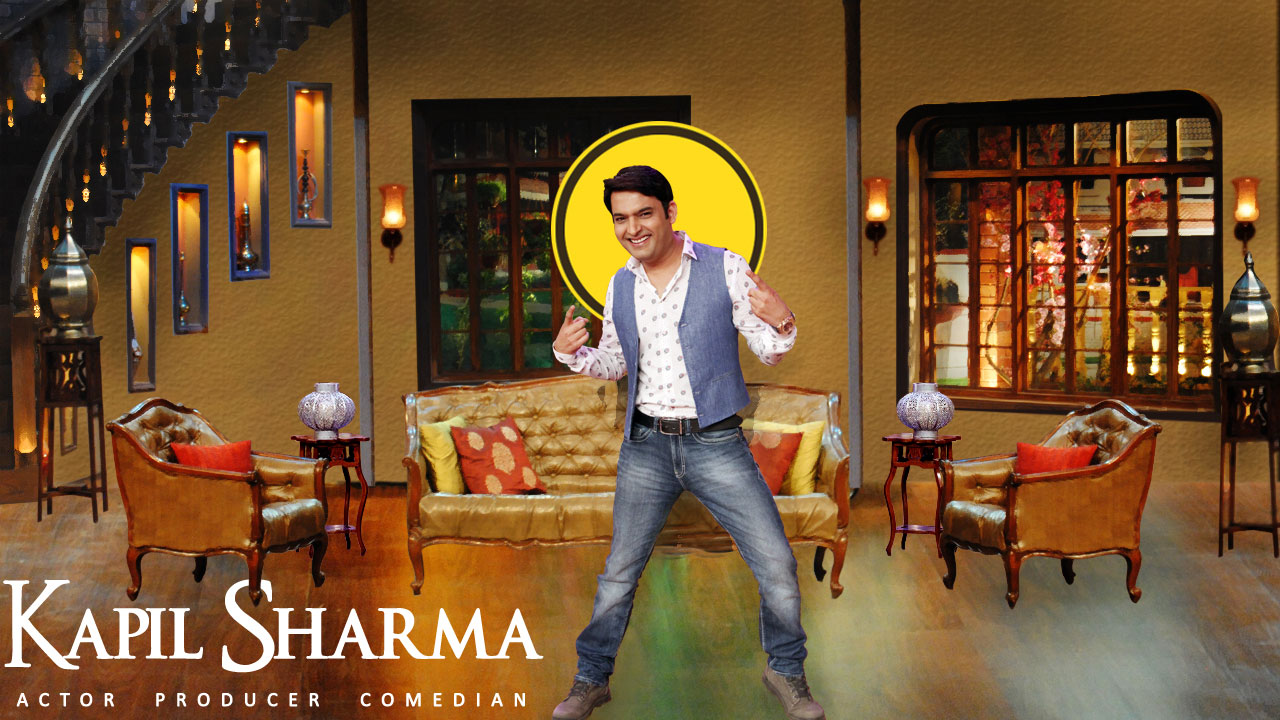
Indian television comedy has a long history of sketch programming, but the Kapil Sharma format did something structurally different: it placed a celebrity guest inside a fictional living room and let the household characters interrogate them. Promotion became performance. Actors arriving to plug a release found themselves in a scene rather than an interview, and the resulting clips travelled far beyond the broadcast slot.
The consistent thread through two decades of work is a refusal to build comedy out of cruelty. The humour is domestic: rent, in-laws, wedding budgets, the small hypocrisies of respectability. It is broad enough for a family audience watching together and specific enough that the details land — a particular kind of aunt, a particular kind of neighbourhood argument. That balance is difficult to sustain across hundreds of episodes, and it is the reason the format has been imitated so widely and matched so rarely.
Alongside television, the live circuit has remained central. Touring shows across India, the Gulf, the United Kingdom, North America and Australia have kept the material tested against real rooms rather than a studio audience primed by a floor manager. Performers who stop touring tend to lose the instinct for what an audience will actually laugh at; the road keeps that instinct honest.
His first national breakthrough was winning the third season of The Great Indian Laughter Challenge in 2007. Before that he performed largely on the Punjabi live-comedy circuit and in college theatre.
Yes. He led Kis Kisko Pyaar Karoon (2015) and Firangi (2017), both built around his comic persona, and took a markedly different, dramatic role in Zwigato (2022) as a delivery rider navigating gig-economy work.
It is the production banner associated with his television and film work, through which he has taken an ownership role in the formats he appears in rather than working purely as a contracted host.
Live touring has remained a regular part of his schedule alongside television, with shows staged both in India and for diaspora audiences internationally.